
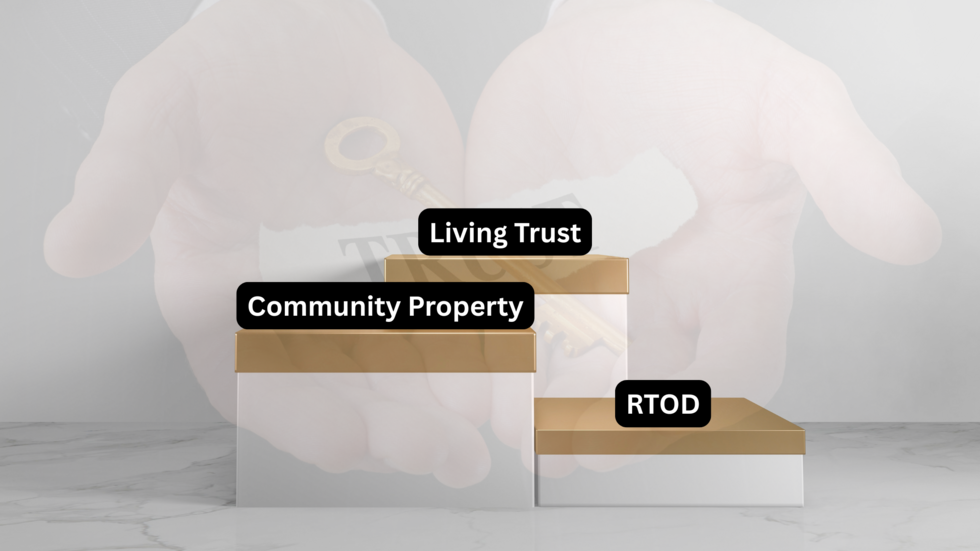
When it comes to protecting your spouse and making sure property passes smoothly, married couples in California often ask me which option works best: Community Property with Right of Survivorship (CPWROS), a Living Trust, or a Revocable Transfer on Death (RTOD) deed. Each choice has unique benefits and limitations, and the right answer depends on your family, financial situation, and long-term goals.
As an estate planning attorney, I want to break down the differences so you can understand why, in most cases, I recommend building your plan around a Living Trust.
Quick Comparison Table
|
Feature |
CPWROS |
Living Trust |
RTOD Deed |
|---|---|---|---|
|
Avoids Probate |
Yes (at first spouse's death) |
Yes (for all assets in trust) |
Yes (for property listed in deed) |
|
Applies To |
Real estate only |
All types of assets |
Real estate only |
|
Tax Benefits |
Full step-up in basis at first spouse's death |
Full step-up in basis if property is community property |
Full step-up in basis if community property |
|
Incapacity Planning |
No |
Yes (successor trustee can manage assets) |
No |
|
Flexibility for Blended Families / Minors |
Limited |
Yes |
Limited |
|
Ease of Setup |
Simple |
Requires attorney guidance & asset transfer |
Simple but must be recorded properly |
|
Control After Surviving Spouse's Death |
None |
Yes |
Limited |
Community Property with Right of Survivorship (CPWROS)
Note: Consider an image of a house with two figures.
CPWROS allows a married couple to hold title to real estate together. When one spouse passes away, the surviving spouse automatically becomes the full owner without going through probate.
It is straightforward and provides excellent tax benefits, but it only applies to real property and does not cover incapacity or second-generation planning.

Living Trust
Note: Consider an image of a family or a secure vault.
A Living Trust is a comprehensive estate planning tool that can hold almost any type of asset. It ensures a smooth transition of property upon death, avoids probate, and provides planning for incapacity.
Trusts are highly customizable, which makes them ideal for blended families, couples with young children, or those who want to control how and when assets are distributed.
Revocable Transfer on Death (RTOD) Deeds
Note: Consider an image of a document being signed or a house with an arrow pointing to another house.
RTOD deeds allow homeowners to transfer real estate directly to beneficiaries upon death. They are relatively new in California (currently authorized through January 1, 2032), simple to create, and effective for avoiding probate on real property.
However, they do not plan for incapacity, only apply to real estate, and can create conflicts if used without coordinating with other estate planning documents.
Frequently Asked Questions
Note: Consider an image of a question mark or a thought bubble.
Q: happens if we only use CPWROS and not a Living Trust?
A: If you rely only on CPWROS, your spouse will inherit the property automatically, but there is no planning for incapacity or what happens after your spouse passes. At the second spouse's death, probate is still required unless another plan is in place.
Q: Are RTOD deeds permanent in California?
A: No. California law currently authorizes RTOD deeds until January 1, 2032. Unless the legislature extends the law, new RTOD deeds cannot be created after that date.
Q: Do all assets need to be placed in a Living Trust?
A: Ideally, yes. A Living Trust only avoids probate for assets that are titled in the name of the trust. If you forget to transfer property into it, probate may still be necessary.
Q: Which option is best for blended families?
A: Living Trusts are generally the best option. CPWROS and RTOD deeds automatically transfer property to the surviving spouse, which can unintentionally disinherit children from a prior marriage. Trusts allow you to balance care for your spouse and children from different marriages.
Q: Is there a tax advantage to CPWROS compared to the other options?
A: Yes. CPWROS provides a double step-up in basis for real property, which can significantly reduce capital gains tax when the surviving spouse later sells. However, trusts can also hold community property and provide the same benefit.
Q: Can I change my mind after creating a RTOD deed or Living Trust?
A: Yes. Both RTOD deeds and Living Trusts are revocable. You can cancel or update them during your lifetime as long as you have legal capacity.
My Recommendation
For California married couples, CPWROS and RTOD deeds can look like quick solutions, but they don't provide the depth of planning most families need. A Living Trust is usually the best foundation because it protects your spouse, plans for incapacity, and ensures your estate is distributed according to your wishes.
Every couple's situation is unique. The best approach is to sit down with an attorney who understands California's estate laws and design a plan that matches your goals and family dynamics. Let's talk! Schedule your FREE 15-minute call with me.


Comments
There are no comments for this post. Be the first and Add your Comment below.
Leave a Comment